
High-Deductible Plan vs. Health Sharing: The Head-to-Head
If you already chose a high-deductible plan, this is the same bet made better.
 In short
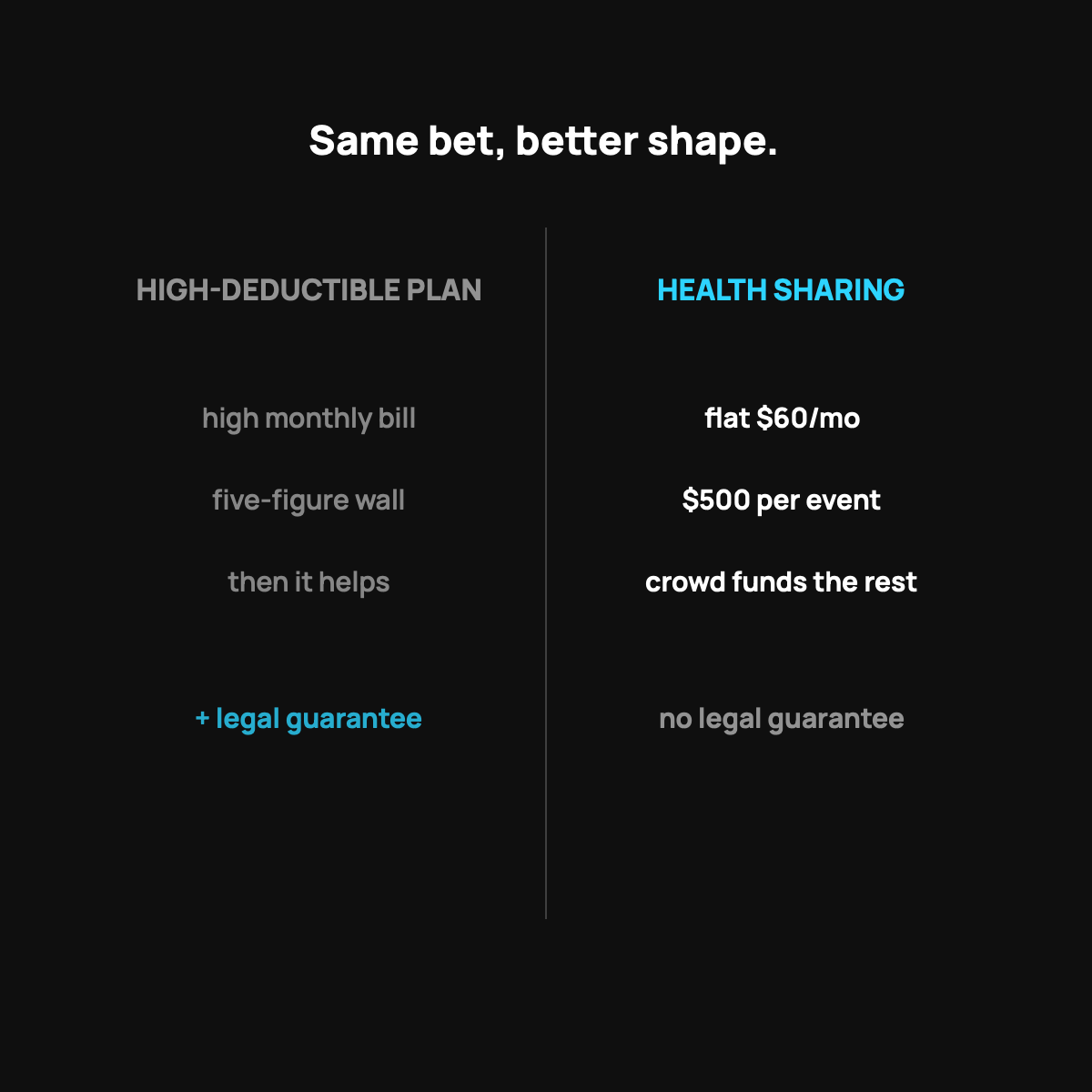
If you're healthy and already on a high-deductible plan to keep costs down, health sharing is usually the same bet made better: a lower monthly number ($60 per person plus a modest crowd contribution) and a $500 step per event instead of a $7,000 to $15,000 wall. The trade is giving up the legal guarantee and the hard out-of-pocket maximum.
A lot of responsible families end up on a high-deductible health plan because it has the lowest monthly bill on the menu. If that's you, you're already comfortable carrying some risk to keep your monthly cost down. That's exactly the mindset health sharing is built for. So let's put them side by side and do the actual math, no spin.
What each one costs you monthly
With a high-deductible plan, you pay a premium every month, and for a family that's often several hundred to over a thousand dollars, even before anyone gets sick. With health sharing through CrowdHealth, the service I use, you pay a flat $60 per person per month, plus a modest monthly contribution to the crowd. For most healthy families, the health sharing monthly number lands lower. I broke down the real monthly math.
So round one, monthly cost, usually goes to health sharing for a healthy family.
What happens when something goes wrong
This is where people get fooled by the word "coverage."
On a high-deductible plan, when a health event hits, you pay the full cost yourself until you reach your deductible, which is often $7,000 to $15,000 for a family. Only after you climb that wall does the plan start paying. You've been paying premiums the whole time, and you still eat the first several thousand dollars.
On health sharing, you pay $500 for the event, and the community funds the rest of the eligible bill after the advocates negotiate it down. No annual wall to climb first.
The math on a real year
Say a family has one solid health event, a $6,000 bill after discounts.
- High-deductible plan: monthly premiums all year, plus the full $6,000 because you likely never cleared the deductible. Easily well over ten grand out of pocket.
- Health sharing: the flat fees for the year, plus $500 for the event. A dramatically smaller total.
Where the high-deductible plan wins
I promised no spin, so here it is. The high-deductible plan is real insurance, which means a legal guarantee and a hard yearly out-of-pocket maximum. Health sharing has neither, because it is not insurance. If you have a chronic condition, take costly ongoing medication, or simply cannot stomach any uncertainty, the guarantee is worth paying for. I wrote the honest who-should-skip-health-sharing list.
The takeaway
If you're healthy and already chose a high-deductible plan to keep costs down, health sharing is usually the same bet made better. Lower monthly cost, and a $500 step instead of a five-figure wall when something happens. The trade is giving up the legal guarantee. For a lot of us, that trade is clearly worth it. For some, it isn't. Now you can tell which one you are.
Questions I get about this
How much does a high-deductible plan cost a family?
Often several hundred to over a thousand dollars a month in premiums, with a family deductible of $7,000 to $15,000 behind it. When a health event hits, you pay the full cost yourself until you reach that deductible, even though you've been paying premiums the whole time.
What does a high-deductible plan have that health sharing doesn't?
It's real insurance: a legal guarantee that covered claims get paid and a hard yearly out-of-pocket maximum. It also lets you open an HSA. If you have a chronic condition, take costly ongoing medication, or can't stomach uncertainty, that guarantee is worth paying for.
What does a $6,000 health event cost on each?
On a high-deductible plan: a year of premiums plus the full $6,000, because you likely never cleared the deductible. Easily over ten grand. On health sharing: the year's flat fees plus $500 for the event, with the community funding the rest of the eligible bill.
Want to run your own comparison? Use my code NORMAL: check CrowdHealth (opens in a new tab). New members get their first 3 months at $99 a month with code NORMAL.
My family of four uses CrowdHealth and I really believe in the model. If you join through my discount link (opens in a new tab) (code NORMAL), you get your first 3 months at $99 a month, and Normaltown USA earns a referral bonus if you stick around. It costs you nothing extra, and I only refer you to things I would tell a friend about. Health sharing is not insurance, and nothing here is medical, tax, or financial advice.

Written by David Dewese
Normal guy with a full-time job, wife, and kids. Spent twenty years pursuing music and creative ventures before starting a family. Sharing tips and tricks on how to thrive while living on an artist's income. Not a financial advisor. More about me.
New here?
Normaltown USA is plain-English money and healthcare help for normal people, written by a regular guy with a family of four. No jargon, no hype. Start here, or read the FAQ.